


 GGC Paediatric Guidelines
Recognition and management of possible physical abuse in infants (children under the age of 1y)

Warning
Objectives
This replaces the previous guideline: Recognition and management of maltreatment in infants (children under the age of 1)
This guideline aims to:
- Assist clinicians in recognising signs of physical abuse in children under one year old
- Ensure clinicians know how to raise concerns about physical abuse to the appropriate people
- Outline the process followed by the child protection team in managing these children after concerns are raised
This guidance should be used in conjunction with other local proformas and guidance available, including:
- The under two injury proforma (see appendix 1)
- Child protection pathways where concern for neglect or abuse – RHC ED
- NOC guideline
Scope
This guidance is aimed at hospital-based practitioners but may also provide useful information for clinicians working in primary care or the community throughout GGC, as well as the other agencies involved in the child protection process.
Children under one year old are at increased risk of physical abuse compared to older children. If they present with injuries, they will be unable to explain what has happened to them and will need a thorough history and examination carried out. They are less independently mobile and therefore less likely to injure themselves accidentally. Consideration will have to be given to whether the mechanism of injury described, fits the injury seen and whether it fits with the child’s stage of development. Any infant with an unexplained injury will require admission for the investigations described below.
The GMC and Scottish Government have stated that clinicians have a responsibility to identify and respond to children who are at risk of suffering child abuse or neglect. 1, 2 Clinicians have a duty to work in partnership with other statutory agencies (Social work and Police) in the identification and investigation of concerns regarding child protection.
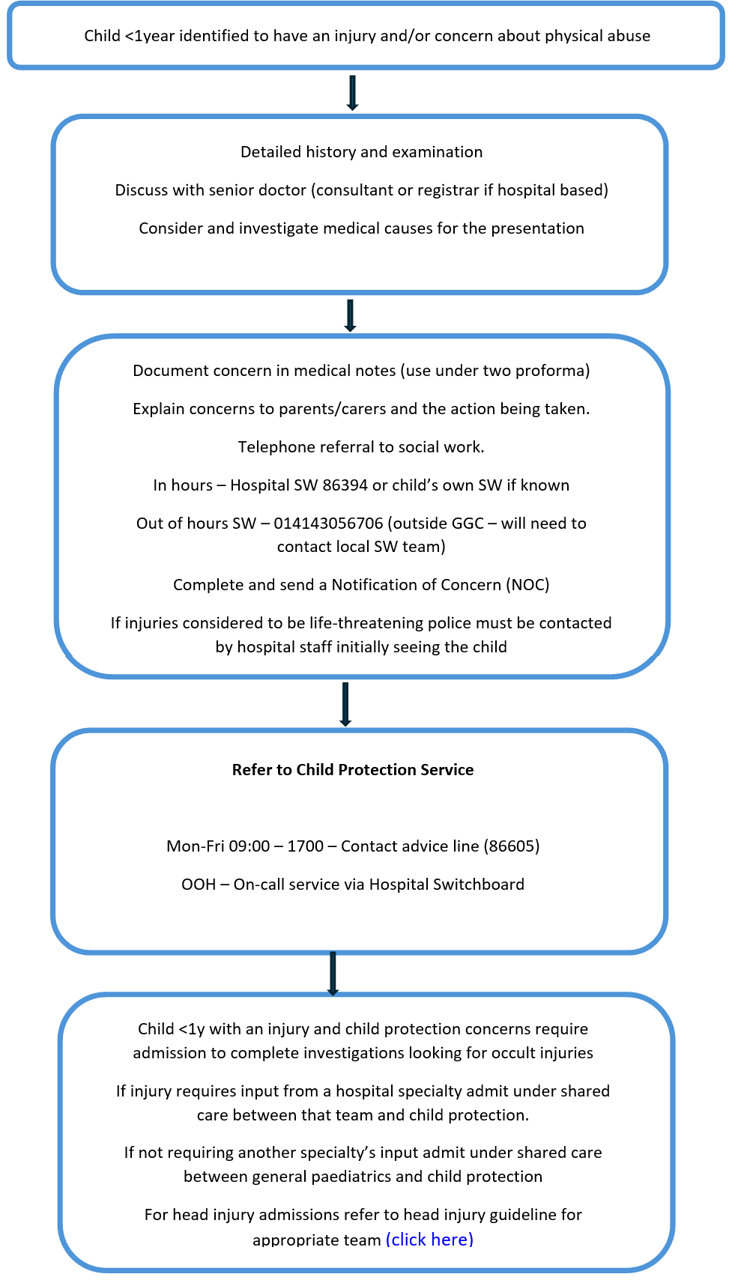
The following flow charts provide an overview of how that process should work, with more detailed information in the guidance notes which follow. The guidance notes contain information to help clinicians recognise features in the history or examination which may be suggestive of abuse.
History
When a child under one is presented to hospital with an injury, it’s essential to obtain a detailed history about how this occurred, ideally from an eyewitness. As part of this history, it’s important to establish what stage of the development the child is at and how independently mobile they are. This should all be recorded on the under 2 years of age injury proforma, this is available on active clinical notes in Trakcare now, a paper copy version is available to download in appendix 1.
Important history points: 3
- What the injuries are and how they presented
- Timing of injuries and preceding events
- The explanations given for the injuries and who gave them
- Any discrepancy evident in the accounts
- Action taken by parents or carers after the injury was discovered
- Any previous injuries
- Explanation seems consistent or not with developmental level of the child.
Features in the history which raise suspicion of physical abuse: 4
- A significant injury with no explanation
- An explanation which does not fit with the pattern of injury seen
- An explanation that does not fit with the motor developmental stage of the child
- Injuries in infants who are not independently mobile, as this age group rarely have accidental injuries
- An explanation which varies when described by the same or different parents/carers.
- Multiple explanations are proposed but they do not explain the injury seen
- An inappropriate time delay in seeking appropriate medical assessment or treatment
- Inappropriate parent or carer response (e.g. unconcerned or aggressive)
- A history of inappropriate child response (e.g. did not cry, felt no pain)
- Presence of multiple injuries
- Child or family known to children’s social care or subject to a Child Protection Plan
- Previous history of unusual injury/illness e.g. unexplained apnoea
Examination
A full top to toe examination should be carried out for these children and documented, along with any injuries found, on the under 2 years of age proforma. This should include measuring and plotting their growth, including head circumference.
Infants who are not independently mobile (rolling/crawling) should not have bruises without a clear explanation for how they occurred.
Features of bruising suggestive of physical abuse: 4
- Bruising/petechia not caused by a medical condition
- Bruising when not independently mobile
- Multiple bruises or bruises in clusters
- Bruises away from bony prominences
- Bruises to the face, eyes, ears, trunk, arms, buttocks and hands
- Bruises carrying the imprint of a hand, ligature or implement used
Further information about specific injuries is available in Chapter 9 of the Child Protection Companion. This available online to RCPCH members and has sections on, Bruises, Bites, Fractures, Abusive Head Trauma, and Abdominal injuries.
Notification of concern and contacting social work
A notification of concern should be filled in when concerns have been raised about an injury in an under one year old. This should be done by the first person seeing the child who has concerns.
The NOC form is available on clinical portal and should be completed alongside a call to social work. Once completed, the form will be available to see on portal and a copy should be e-mailed to the relevant social work team and to the child protection advisors.
Only in exceptional circumstances would a family not be informed of a NOC being completed e.g. if you felt it put staff or the child in danger.
Further information on the NOC process (includes social work e-mail addresses) can be found here.
If the family are not known to social work, then, in hours, hospital social work can be contacted to discuss any concerns about the child. If the family are known to social work, it would be more useful to contact their own social work team who will have more information available about the family.
|
Social work area |
Contact details |
|
Glasgow City |
0141 287 0555 |
|
Renfrewshire |
0300 300 1199 |
|
East Renfrewshire |
0141 577 8300 |
|
East Dunbartonshire |
0141 777 3000 |
|
West Dunbartonshire
|
0141 562 8800 |
|
Inverclyde
|
01475715365 |
It should be highlighted to social work at this stage if there are any other siblings at home who may be at risk, to allow social work to identify a place of safe care. Any conversations had with social work should be clearly documented in the notes and include the name of who you spoke to.
Contacting the police
If the child has a life-threatening injury you must involve the police early in the process. If you are concerned about an ongoing threat to a child that would be via 999, otherwise, depending on the time of day, you may be able to use the numbers or you may need to go through 101.
Glasgow Public Protection Police Hub can be contacted on the following numbers (until about 9pm):
- 0141 532 6763/6723/5583/5414/5584
Glasgow Child Abuse Unit can be contacted on the following numbers (until about 1am):
- 0141 532 6703/6742/6793
Child Protection team assessment
Medical Examination Process
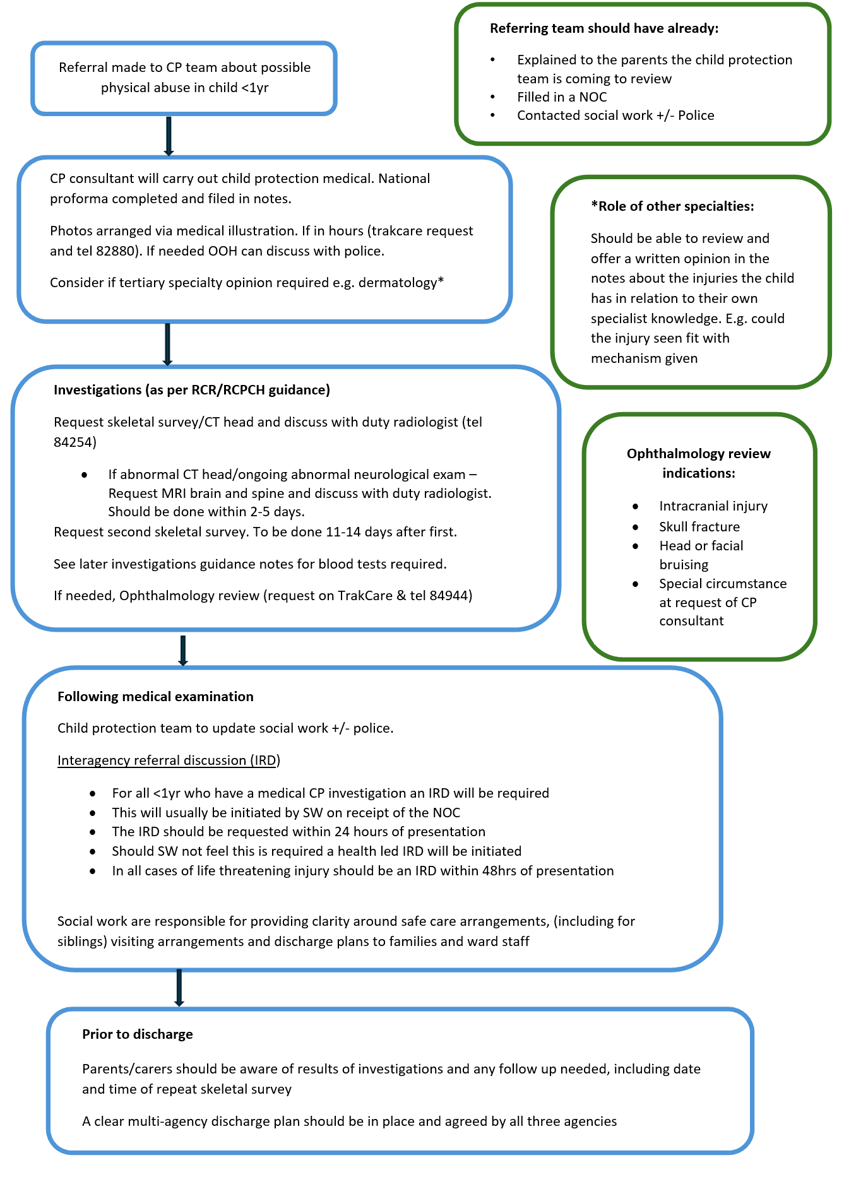
After a referral has been made the child and their family will be seen by the child protection consultant on call that day. Consent for the medical examination, photography and investigations must be obtained from someone with parental responsibility. The proforma for carrying out a child protection medical examination is available here.
Parents and carers can be provided with information leaflets on the medical examination process and the radiological investigations that may be required.
Any injuries found will be documented on the proforma and photographs taken by medical illustration. In hours they require a trakcare request to be filled in. This is available under the ‘other’ tab and comes up as ‘Clinical photo/Video.’ Once requested, call the department on 82880. Out of hours or over the weekend this service is not available, if urgent pictures need taken the police may be able to arrange this via SOCO (scene of crime photography) but this will need to be discussed with them.
Social work should be updated following the medical examination, this may take place at the IRD or sooner if the medical has taken place out of hours. If following the examination the child protection consultant feels police should be updated prior to IRD they should do so.
The investigations outlined in the flow chart above are the standard investigations carried out as part of a child protection investigation. Other investigations may be required depending on the injuries the child has, or the concerns raised. If a child has presented very acutely unwell they may also be having other investigations or treatment for possible medical conditions until more information is available.
The RCPCH child protection companion recommends if a skeletal survey is being performed then bone biochemistry investigations should be done at the same time, whether there is known to be a fracture or not.2 This includes Calcium, Phosphate, Alkaline Phosphatase, Vitamin D and Parathyroid hormone.
If the child has evidence of bleeding or bruising, they should have baseline haematology bloods including a full blood count, blood film, coagulation studies and fibrinogen. If there are concerns about an underlying clotting abnormality, the Haematology Investigations in Suspected Physical Abuse in Children Guideline should be used to guide any additional tests sent. This may also require a discussion with haematologist on call.
Ophthalmology review, looking for retinal haemorrhages may not be required for all children. It should be asked for in children who have been found to have an intracranial injury, skulls fractures or have bruising or injuries to their face. This requires a referral on Trakcare which can be found on the ‘other’ tab as ‘ophthalmology inpatient referral – paediatric’ and a phoned referral (tel 84944).
This is the formal process of information sharing between health, police and social work following a reported concern. One of these agencies will lead the IRD but everyone in attendance will contribute the information they have. Ideally, this would be attended by the child protection consultant who will doing or has done the medical examination of the child being discussed. If they are unable to attend a summarised written opinion will be provided and the child protection consultant on call that day may attend.
Following the information sharing process a joint decision will be made about whether the threshold has been reached for a child protection investigation and if so, what should happen next, in terms of either a single or joint agency investigation.
Part of this process will involve discussing the need for ‘safe care’ of the child until this process in complete. This would often involve additional family members being involved in supervising the parents or carers of the child in question. Depending on the circumstances it may be more appropriate to consider a foster care placement. Social work will make the final decisions on safe care arrangements, and these should be communicated to the parents by them. Whilst the child remains an inpatient, ward staff will need to be updated and aware of these arrangements to know who can visit and look after the child.
If the child with an injury and concerns about physical abuse has a twin, they should also have a medical examination and undergo the same radiological investigations. If the child being seen has older siblings, particularly if young and non-verbal, consideration should also be given to examining them and investigating as appropriate.
Prior to being discharged from hospital the available results for investigations should have been communicated to the parents. If some results are still pending these should remain on the child protection handover and be communicated to the family and social work when available.
The parents/carers should also ideally have the date and time for their repeat skeletal survey and understand the importance of coming back for this. This should also remain on the child protection handover until reported and fed back to the family and social work.
A clear plan should be in place from social work about who the child is going home with and who is allowed to look after them whilst the child protection investigations are being completed.
Further information and guidance can be found in:
- National Guidance for Child Protection in Scotland 2021 (Supporting documents - National Guidance for Child Protection in Scotland 2021 - updated 2023 - gov.scot)
- RCPCH Child Protection Companion (available online for RCPCH members)
- RCPCH Child Protection Evidence – systematic reviews (available online for RCPCH members)
- Local Guidelines
Under 2 Injury Proforma (Word document)