

 GGC Paediatric Guidelines
- BBV: Blood Borne Virus (HIV, Hepatitis B, Hepatitis C).
- PEP: Post-exposure prophylaxis for HIV.
- HBsAb: Hepatitis B surface antibody level.
- Green Book: UK Immunisation Against Infectious Disease guidance.
- Penetrating injury/stab wounds: Any blood-to-blood transfer from a metal implement (such as a knife/machete) with any break in the skin barrier.
- HIV – Human immunodeficiency virus
- HBV – Hepatitis B Virus
- HCV – Hepatitis C Virus
Blood Borne Virus (BBV) prophylaxis for penetrating/percutaneous exposure from sharp object to young people in the community

Warning
Objectives
To provide clear guidance on the assessment, testing, and management of patients who present with penetrating stab wounds, with specific focus on the consideration and provision of Blood Borne Virus (BBV) prophylaxis.
NB - There is separate guidance for staff occupational exposure through needle-stick injury – this guidance is not for that cohort.
Audience
This SOP applies to all clinical staff involved in the assessment and treatment of patients presenting with intentional penetrating injuries. This would include Emergency Department staff, Minor Injury Units, Major Trauma teams, and inpatient medical/surgical teams.
Admitting Clinical Team (or ED team, if discharged from ED):
- Offer baseline BBV testing.
- Administer vaccinations where indicated.
- Trakcare referral for ongoing Public Health vaccinations at one month, two months and 12 months post injury. (select patient’s admission episode on Trakcare; New Request; Other; search “Public Health” and select for childhood immunisation.
- Ensure follow-up testing at 6-months.
Infectious Diseases (ID) Team:
- If positive result at 6-months – refer to ID team for ongoing management.
1. Initial Assessment
For all patients presenting with penetrating stabbing injuries:
- Assess clinical condition and stabilise as per trauma protocols.
- Consider the risk of BBV exposure based on:
- Source of sharp instrument.
- Known risk behaviours or status of assailant (if available).
- Whether the weapon has been used on multiple people.
2. Baseline BBV Testing
All patients
🡆 Offer baseline BBV testing (not storage) including:
- HIV
- Hepatitis B
- Hepatitis C
(Trakcare – use “BBV Screen Set”)
Patients born on or after 2017 and fully vaccinated
- Also Check HBsAb serology
3. Hepatitis B Vaccination
3.1 Initial Dose
All patients should be offered:
🡆 1 dose of Hepatitis B vaccine in the acute setting.
3.2 Booster / Accelerated Courses
If baseline HBsAb <10 IU/L, or previously unvaccinated, then:
- Complete accelerated Hepatitis B schedule at 0, 1, and 2 months (per BNF / Green Book).
- One dose should be provided as an inpatient.
- Remaining doses arranged via TrakCare (New request → Other → Public Health).
For fully vaccinated patients born ≥2017 with confirmed immunity, no additional Hepatitis B doses are required.
4. HIV Post-Exposure Prophylaxis (HIV PEP)
HIV PEP should NOT be routinely offered. If HIV PEP is considered, discuss urgently with on-call ID team.
It should only be considered if:
- The stabbing implement is known to be contaminated with HIV-infected blood, or
- There is confirmed high-risk exposure (e.g. stabbing implement used on other individuals in high-risk BBV groups such as intravenous drug users)
5. Follow-up Testing
6-month BBV testing (for all)
- HIV
- Hepatitis B
- Hepatitis C
🡆 The admitting team is responsible for arranging this.
🡆 Testing should be booked through Ward 1C / Outpatient Department, not GP, to ensure results route to the responsible clinical team.
Optional 3-month testing
May be offered to higher-risk cases, such as:
- Weapon used on multiple individuals
- Known high-risk group exposure
HIV/HCV will be detectable at 3 months, but a small number of HBV remain undetectable until 6-months. If there is significant parental/patient anxiety and/or there is significant high risk, then testing at 3 months can also be offered.
Testing again at 6‑months should still always be offered.
Clinicians must document:
- Baseline testing offered and completed.
- Vaccination given (including batch number).
- Risk assessment for HIV PEP.
- Referrals made (e.g., community vaccination team).
- Follow-up plans arranged.
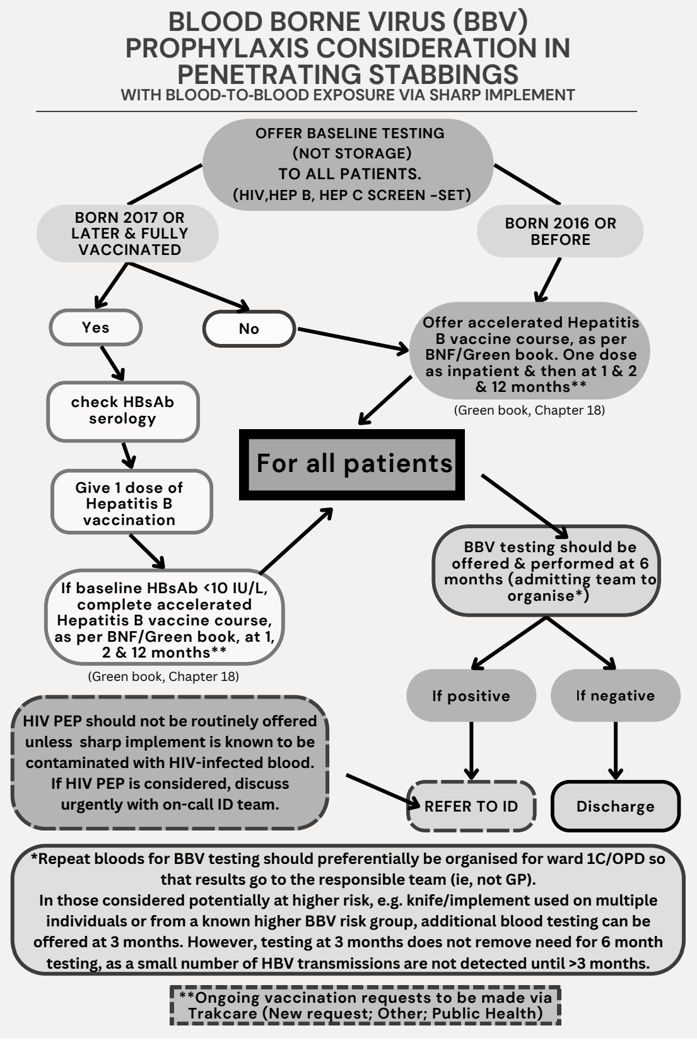
How to use this flow chart
This flow chart is designed as a quick‑reference clinical aid to support the assessment and management of patients presenting with penetrating stab injuries where there has been blood‑to‑blood exposure via a sharp implement.
It should be used alongside the accompanying Standard Operating Procedure (SOP): BBV Prophylaxis for Penetrating Injuries, which provides full procedural detail and governance context.
The flow chart guides clinicians through:
- Identification of patients requiring baseline blood borne virus (BBV) testing
- Assessment of hepatitis B immunisation status and provision of vaccination
- Consideration of HIV post‑exposure prophylaxis (PEP), including when specialist advice is required
- Arrangements for follow‑up BBV testing and referral
The flow chart applies to patients only and does not cover occupational exposures in healthcare staff (e.g. needlestick injuries), for which separate guidance exists.
Clinical judgement should always be applied, and where there is uncertainty — particularly regarding HIV PEP — early discussion with the on‑call Infectious Diseases team is recommended.