Note 1: immunisation status
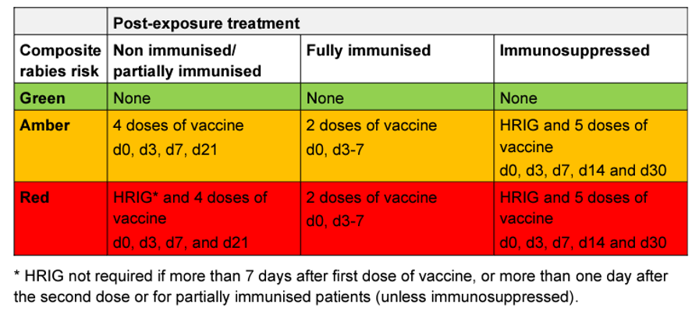
Most children will not have had previous rabies immunisations. To be considered fully immunised they would need EITHER:
- a well documented pre-exposure or post-exposure course of rabies immunisations
- a recent documented rabies antibody titre of at least 0.5 IU/ml
If in doubt, manage as the child as if they are unimmunised.
Note 2: Immunosuppression
For the purposes of rabies risk assessment, a child should be considered immunosuppressed if they fulfil the criteria for immunosuppression in Annexe 1 of the document linked below:
Guidelines on managing rabies postexposure (UK Health Security Agency, January 2023)
Note 3: Allergies
There are no contraindications to post-exposure treatment with rabies vaccine (including Rabipur for those with severe egg allergies). In the event of a hypersensitivity reaction to a dose of a pre-exposure course, such individuals should still receive post-exposure immunisation if indicated, because the risks of rabies outweigh the risks of hypersensitivity. When there is a history of a hypersensitivity reaction to rabies immunisation, seek advice.
Note 4: Bleeding disorders
If vaccinations are required and the child has a bleeding disorder, if may be more appropriate for these to be given subcutaneously. Seek advice if unsure.
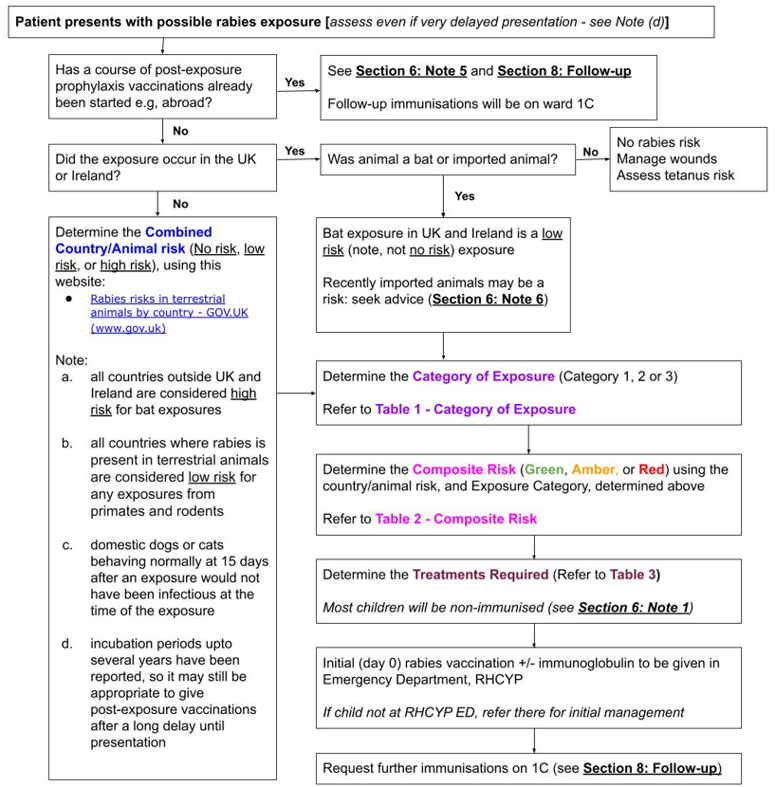
Note 5: Immunisation schedules already started
The risk assessment above should be completed. Where a regime has been started that is different from what would have been used in the UK, advice should be sought from the paediatric ID team in daytime hours (between 9 am and 5 pm), e.g. the following day if out of hours (Section 9: Sources of Advice).
Arranging follow-up immunisations
- If the patient is in ED, follow-up immunisations should be requested for 1C as per Section 8: Follow-up
- If the patient is in Primary Care, please contact the ID team in-hours (as per Section 9: Sources of Advice). who will assist in arranging follow-up. Please have the details required for the Risk Assessment to hand.
Note 6: Exposure to recently imported animals
Animals recently imported into the UK may pose a rabies risk. If the animal is in a facility (e.g, zoo), discuss with the responsible veterinary surgeon to determine the risk.
Legal importation of pets from outside the UK requires
strict guidance to be followed including rabies vaccination of the animal. Legally imported animals should have a Pet Passport, Animal Health Certificate, or Great Britain Pet Health Certificate. The risk of rabies from animals with these certificates is considered negligible, and no rabies post-exposure prophylaxis would be required.
If you suspect an animal has been illegally imported (e.g, domestic dog), discuss with paediatric infectious diseases team. Suspected illegally imported animals must also be reported to the Local Authority Trading Standards (in Glasgow: 0141 287 1061). If you suspect the animal has rabies, this must be immediately reported to the Animal and Plant Health Agency (telephone 03000 600 704).