


Bariatric patients, PICU SOP

Objectives

To provide clear, evidence-based recommendations for the management of critical illness in the bariatric child and young person.

Scope

This guideline is intended for all healthcare professionals caring for overweight or obese children (<16 years old) with critical illness in the Paediatric Intensive Care Unit at the Royal Hospital for Children, Glasgow.

Audience

All medical and nursing staff caring for children with critical illness.

1. Defining the bariatric child

  • Identifying obesity in children can be challenging
  • Obesity is defined by the WHO as abnormal or excessive fat accumulation that presents a risk to health
  • Although BMI is a commonly used tool to identify obesity in adults, additional anthropometric measures and physical examination are typically required to confirm the diagnosis in children 
  • Different BMI thresholds are used for population surveillance and clinical practice 

Population surveillance

Overweight >85th centile

Obese >91st centile 

Clinical practice

Overweight >91st centile

Obese >98th centile 

BMI thresholds for the diagnosis of obesity in children have no supporting evidence base but are endorsed by RCPCH 

Step 1. Calculate BMI 

Weight (kg) ÷ Height (m2) = BMI 

Step 2. Plot BMI on RCPCH growth chart

        Follow QR code

Alternatively, consult RCPCH online for growth charts at https://www.rcpch.ac.uk/resources/growth-charts

Step 3. Define Weight Category

BMI centile

          Weight category

>91st

Overweight

>98th

Obese

>99.8th

Severely obese

2. AIRWAY considerations for the bariatric child

Reduced functional residual capacity → Increased risk of desaturation during induction of anaesthesia

  • Pre-oxygenate as tolerated (face mask, high flow nasal cannula, or non-invasive ventilation)
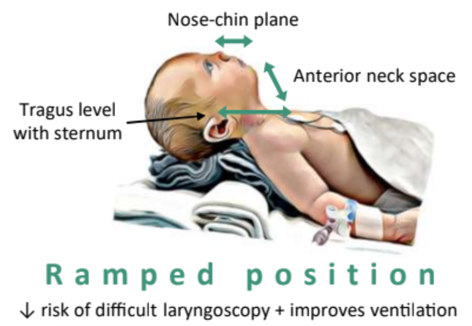
  • Use a RAMP position with either bedside pillows or an Oxford HELP pillow to minimise diaphragmatic splinting

Higher intra-abdominal pressures → Increased risk of aspiration

  • Gastric transit times may be longer and true fasting status may never be achieved
  • Consider decompression of the stomach with a nasogastric tube and continual aspiration

More adipose in upper airway soft tissues → Airway obstruction occurs early following induction of anaesthesia

  • Watch for signs of obstruction with face mask ventilation
  • Beware of insufflating the stomach


FACE MASK VENTILATION = MORE DIFFICULT

Always use an oropharyngeal (Guedel) airway plus a 2-hand 2-person technique as standard

SUPRAGLOTTIC AIRWAY INSERTION = MORE DIFFUCLT

Use a second generation supraglottic airway device such as an iGEL (sized based on total body weight)

INTUBATION = NOT MORE DIFFICULT

Incidence of difficult intubation is not more common; however, have a low threshold for video laryngoscopy

3. BREATHING - Ventilating the bariatric child

Reduced lung compliance → Higher ventilatory pressures with greater risk of barotrauma

  • Target a higher PEEP to encourage alveolar recruitment and prevent basal collapse / avoid atelectasis
  • Aim for lung protective ventilation (6-8ml/kg based on ideal body weight)
  • Use a pressure control mode of ventilation to avoid barotrauma 
  • Consider iatrogenic pneumothorax if patient deteriorates on the ventilator
  • Spontaneously ventilating patients will need higher levels of pressure support
  • Consider transpulmonary pressure monitoring if high ventilatory pressures are a persisting concern
  • Be aware that there is an associated higher incidence of bronchospasm in obese children
  • Consider echocardiography to evaluate for right heart failure if failing to wean from ventilator
  • Consider extubating onto NIV if features in history concerning for obstructive sleep apnoea  

4. DRUGS - Emergency anaesthesia for the bariatric child

As a rule, never exceed maximum adult doses when prescribing for children. Please refer to the Society of Obesity and Bariatric Anaesthesia (SOBA) paediatric guidelines for more information.

Total body weight (TBW)

Actual measured body weight in kilograms (kg)

Ideal body weight (IBW)

BMI50 x height (m)2    

where BMI50 = age and sex specific BMI at 50th centile

Adjusted body weight (AdjBW)

IBW + 0.35 x (TBW – IBW)

Commonly used drugs in PICU and appropriate dosing strategies

Total body weight

Ideal body weight

Adjusted body weight

  • Atropine
  • Dexamethasone
  • Ondansetron
  • Penicillins
  • Cephalosporins
  • Enoxaparin
  • Suxamethonium


  • Propofol (induction bolus)
  • Ketamine
  • Morphine*
  • Rocuronium* (including any other non-depolarising muscle relaxants)
  • Dexmedetomidine (clonidine)
  • Local anaesthetics
  • Adrenaline

*in practice in PICU we dose morphine and rocuronium by total body weight except when advised otherwise by Duty Pharmacist.

  • Propofol (infusion)
  • Fentanyl
  • Paracetamol
  • Ibuprofen
  • Gentamicin


For ongoing management in PICU, refer to the adolescent handbook for all children above 50kg (located at PICU staff base 2). For bariatric children below 50kg seek expert pharmacy advice or use best clinical judgment.

5. Specific drug risks

Propofol → Propofol Related Infusion Syndrome (PRIS)

  • Profound bradycardia → Asystole in the presence of metabolic acidosis, rhabdomyolysis, or hyperlipidaemia
  • Children are at higher risk of PRIS due to relatively lower glycogen stores and dependence on fat metabolism
  • Do not exceed propofol infusion rates of 4mg/kg/hr
  • Do not exceed 48hrs of continuous infusion unless documented PICU consultant authorisation
  • Prevention / management
    • Monitor lactate at least 12 hourly. Monitor creatine kinase and triglyceride levels daily after 48 hours of propofol infusion.
    • If any unexplained rise in lactate, CK or triglycerides STOP PROPOFOL IMMEDIATELY and inform PICU Consultant.
    • Avoid propofol in patients with relatively low carbohydrate to high lipid intake (e.g., consider starting glucose infusion and stopping lipid component of parenteral nutrition)
    • Stop propofol and start alternative sedative agents (e.g., morphine and midazolam/clonidine/dexmedetomidine)
    • If propofol must be continued >48hrs for clinical reasons, cycle off propofol for 12 hours every 48 hours.
    • Provide cardiovascular and renal support as required

Dexmedetomidine → Bradycardia, hyperthermia

  • Highly selective alpha-2 adrenoreceptor agonist frequently used to reduce delirium and facilitate extubation
  • Do not exceed dexmedetomidine infusion rates of 1.4mcg/kg/hr (dose based on ideal body weight)
  • All bariatric patients on
  • Risks include bradycardia and hypotension
  • Discontinuation syndrome can occur (reflex tachycardia and hypertension)
  • There is an established association with hyperthermia – this risk may be greater in bariatric patients.
  • NB: Clonidine may also interfere with thermoregulation although the risk is probably less than with dexmedetomidine.
  • All patients on alpha-2 adrenoceptor agonist infusions must receive continuous core temperature monitoring.

6. Nutrition, skin integrity, and manual handling

  • Energy requirements for the bariatric child in critical care are calculated based on ideal body weight, consider liaising with adult dietetics for additional guidance
  • Blood glucose monitoring is required for these children as they have a higher risk of insulin resistance and type 2 diabetes mellitus (may be precipitated by critical illness or high dose steroids in intensive care) 
  • Pressure care Always conduct a risk assessment and follow NHS GGC guidance
  • Non-invasive blood pressure cuffs must be sized appropriately – cuffs that are too small will overestimate blood pressure and cuffs that are too big will underestimate blood pressure
  • Manual handling Always follow NHS GGC guidance and local manual handling training. Standard approach for bariatric children is to use a PAT slide with a glide sheet; however, use a hover mattress if weight >90kg (may be available from adult critical care)
  • Early mobilisation is essential for any bariatric child receiving intensive care.
  • Adequate hydration Repeat clinical assessment may be required as calculated fluid requirements may not be accurate at extremes of weight
  • Venous thromboembolism (VTE) prophylaxis
    • Always perform a risk assessment and check NHS GGC guidance
    • Anti-thrombotic stockings if >40g
    • Consider prophylactic LMWH but obesity alone is not an indication if <16 years
    • Seek specialist haematology advice if unsure

7. PICU daily care bundle for the critically ill bariatric child

F

Fluids

  • Calculated fluid requirements may be inaccurate
  • Repeated clinical assessment is needed
  • Consider cardiac output monitoring

Feeding

  • Nutritional requirements should be calculated based on ideal body weight
  • Avoid propofol infusions with lipid parenteral nutrition. Monitor triglycerides DAILY.

L

Lines

  • Vascular access may be challenging
  • Invasive lines may remain in situ longer with increased risk of catheter related bloodstream infection 

Laboratory testing

  • Polycythaemia/raised bicarbonate may indicate hypoxaemia secondary to obstructive sleep apnoea
  • Liver function tests may be deranged as part of a non-alcoholic fatty liver disease process
  • Subclinical hypothyroidism may occur (high TSH / normal T3 + T4)

A

Analgesia

  • Ensure pain is adequately controlled
  • Patient controlled analgesia is appropriate and safe to use (prescribe morphine based on ideal body weight and fentanyl based on adjusted body weight)

Adjustment of dosing

  • Pharmacy should confirm dosing is appropriate based on hepatic/renal function, age, weight, drug interactions and clinical condition  

T

Thromboprophylaxis

  • Early mobilisation is key
  • Mechanical prophylaxis with TED stockings if >40kg. FlowTron garments may also be used if appropriate.
  • Consider LMWH as per PICU guideline but obesity alone is not an indication <16 years

H

Head up position (30o)

  • Reduces risk of aspiration and ventilator associated pneumonia
  • Passive regurgitation may be more common in bariatric patients due to high intra-abdominal pressures

U

Ulcer prophylaxis

  • Prescribe ulcer prophylaxis (proton pump inhibitor or histamine type 2 receptor antagonist) for all children who are ventilated but not feeding. There is no evidence to support altered dosing so calculate based on total body weight

Usual medication

  • More likely to be prescribed medication in the community which may need to be continued

G

Glycaemic control

  • Higher risk for hyperglycaemia during stress response or with insulin resistance and type 2 diabetes mellitus – may require variable rate insulin infusion for optimal management

S

Sedation

  • ALWAYS use the minimum effective dose of sedation needed to achieve the target Comfort-B score.
  • Daily sedation holds may reduce length of stay in PICU; some sedative agents (e.g. benzodiazepines) accumulate in adipose tissue. Ideally hold sedation until Comfort-B score is >17 then re-sedate. Holding sedation may not be appropriate e.g. if ongoing critical airway, severe respiratory failure, haemodynamic instability, requirement for neuroprotection, or control of agitation.
  • ALWAYS consider non-pharmacological measures (protect the sleep-wake cycle (melatonin), music, noise cancelling headphones, TV/iPad, comfort items, toys, family presence, etc.)
  • Where clinically appropriate, nasal intubation may improve ETT tolerance and reduce sedation burden.
  • Consider early tracheostomy if nasal intubation is not possible and the duration of ventilation is likely to exceed 10 days.
  • Ensure correct dosing for propofol (check clinical response with Comfort B score) and monitor laboratory tests for PRIS after 48 hours (twice daily lactate, daily CK & triglycerides)

8. Aftercare

When well enough, all bariatric inpatients should be assessed by a Paediatric Dietitian, Physiotherapist (+/- Occupational Therapist) to develop a weight management plan before discharge. Clinical Psychology assessment may be useful if behavioural or mental health concerns are a factor. Special consideration should be given to children with hyperphagic behaviours (e.g. Prader-Willi Syndrome, ROHHAD syndrome) – these children should be assessed by Paediatric Endocrinology and CAMHS.

Following discharge all bariatric children should be followed up with their GP for lifestyle and dietary interventions to reduce their risk of future complications arising from obesity.

Editorial Information

Author(s): B Scally, C Begg.

Author email(s): Colin.Begg@nhs.scot.

Related resources

SOBA. Anaesthesia for Children living with Obesity - Single Sheet Guideline. 2024

Wynn-Hebden A, Bouch DC. Anaesthesia for the obese patient. BJA Education. 2020;20(11):388.

Chidambaran V, Tewari A, Mahmoud M. Anesthetic and pharmacologic considerations in perioperative care of obese children. Journal of clinical anesthesia. 2018;45:39–50.

NHS Children's Acute Transport Service. CATS Bariatric Patient Transfer Safety: Standard Operating Guidance. 2018; NHS;

Anderson BJ, Holford NH. What is the best size predictor for dose in the obese child? Pediatric Anesthesia. 2017;27(12):1176.

Grayson KED, Tobin AE, Lim DTK, et al. Dexmedetomidine-associated hyperthermia: A retrospective cohort study of intensive care unit admissions between 2009 and 2016. Anaesthesia and intensive care. 2017;45(6):727–36.

Pompilio CE, Pelosi P, Castro MG. The Bariatric Patient in the Intensive Care Unit: Pitfalls and Management. Curr Atheroscler Rep. 2016;18(9)

Nightingale CE, Margarson MP, Shearer E, et al. Peri‐operative management of the obese surgical patient 2015. Anaesthesia. 2015;70(7):859.

Jamadarkhana S, Mallick A, Bodenham AR. Intensive care management of morbidly obese patients. Continuing Education in Anaesthesia Critical Care; Pain. 2014;14(2):73.

Bellamy MC, Margarson MP. Designing intelligent anesthesia for a changing patient demographic: a consensus statement to provide guidance for specialist and non-specialist anesthetists written by members of and endorsed by the Society for Obesity and Bariatric Anaesthesia (SOBA). Perioper Med. 2013;2(1):12.

Owen J, John R. Childhood obesity and the anaesthetist. Continuing Education in Anaesthesia Critical Care &amp; Pain. 2012;12(4):169.

Philippi-Höhne C. Anaesthesia in the obese child. Best practice & research. Clinical anaesthesiology. 2011;25(1):53–60.