Newborn pulse oximetry screening

Warning

Audience

This guideline is intended for use by all health care staff within NHS Greater Glasgow and Clyde (GG&C) caring for newborn infants.

1. Background

Pulse oximetry screening (POS) in newborns was introduced across NHS Greater Glasgow and Clyde (GG&C) in December 2023. POS is simple, cost effective, non-invasive and highly specific for Critical Congenital Heart Disease (CCHD). Importantly it can detect CCHD in newborn babies before symptoms arise and potentially before discharge home from hospital. (1)

Congenital heart disease is one of the most common types of birth defect affecting up to 8 in every 1000 babies born in the UK. CCHD occurs in around 2 in every 1000 newborn infants and is a leading cause of infant death. Antenatal detection rates range from 33-62%.  (2) 

 Most newborns with CCHD are asymptomatic at birth. Clinical examination does not always detect babies with CCHD with up to 1/3rd of babies discharged home from maternity care with an undiagnosed cardiac condition. Early detection and treatment of babies with CCHD before acute cardiovascular collapse improves outcome and reduces the risk of death. (3)

POS can also detect other important pathology in babies which present with low saturations or a difference in saturations. This includes infection, pneumothorax and pulmonary hypertension. (1,4).  A report conducted in 2023 indicated that 78% of UK neonatal units were undertaking POS (Ewer AK, Edi-Osagie N, Adams E, unpublished).

2. Which Babies are Eligible for POS

All babies in born in NHS Greater Glasgow & Clyde 34 weeks gestation or above are eligible for routine pulse oximetry screening. The majority of babies having POS will be managed by midwives and midwifery care assistants in the post-natal wards and will have normal saturations (Green pathway). The neonatal team will only be involved in a minority of babies who are on the amber and red pathways and when the baby is admitted to the Neonatal Unit (see section 7).

3. Timing of Pulse Oximetry Screening

Timing of the POS is dependent on where the baby is located: in the post-natal wards, in the Neonatal Unit or in the Community.

  • For babies in the postnatal ward, POS is performed at 6-8 hours of life by the midwife/HCA looking after the baby.
  • For babies born at home, POS is performed within the first 24 hours of life, at the first community midwife check after birth.
  • Any baby admitted to the neonatal unit, if 34 weeks’ gestation or above, will have a POS performed prior to discharge from the neonatal unit (see section 7)
  • No infant should leave hospital without having pulse oximetry screening, unless the parents have declined screening after a fully informed discussion with their reasons being fully documented in the medical notes.

The attending neonatal consultant should be made aware of any baby on the red pathway.

4. Measurement of Pre and Post Ductal Saturations

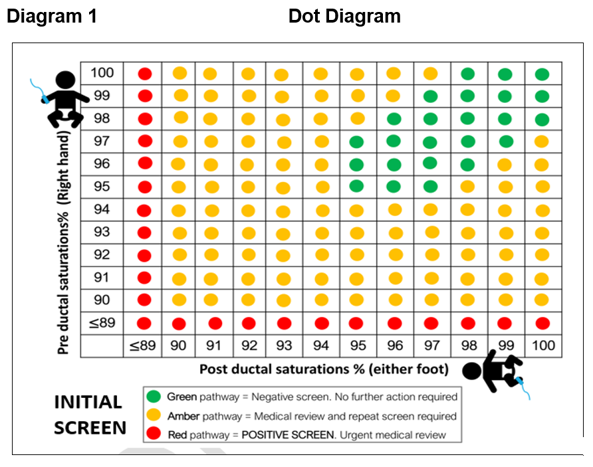
POS involves the measurement of pre- and post-ductal saturations. In the post-natal wards and community this will be with a Masimo Rad G handheld pulse oximeter. 

Masimo Rad G pulse oximeter.

  • The sensor is REUSABLE. Please do not discard.
  • The blue foam wrap is single patient use.

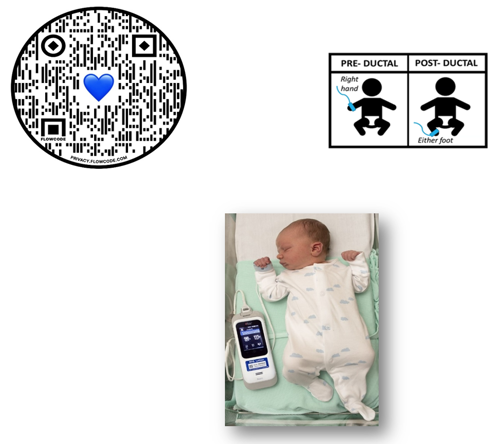
Scan the QR code below to view a short video on how to use the Massimo Rad G pulse oximeter:

5. POS Pathways

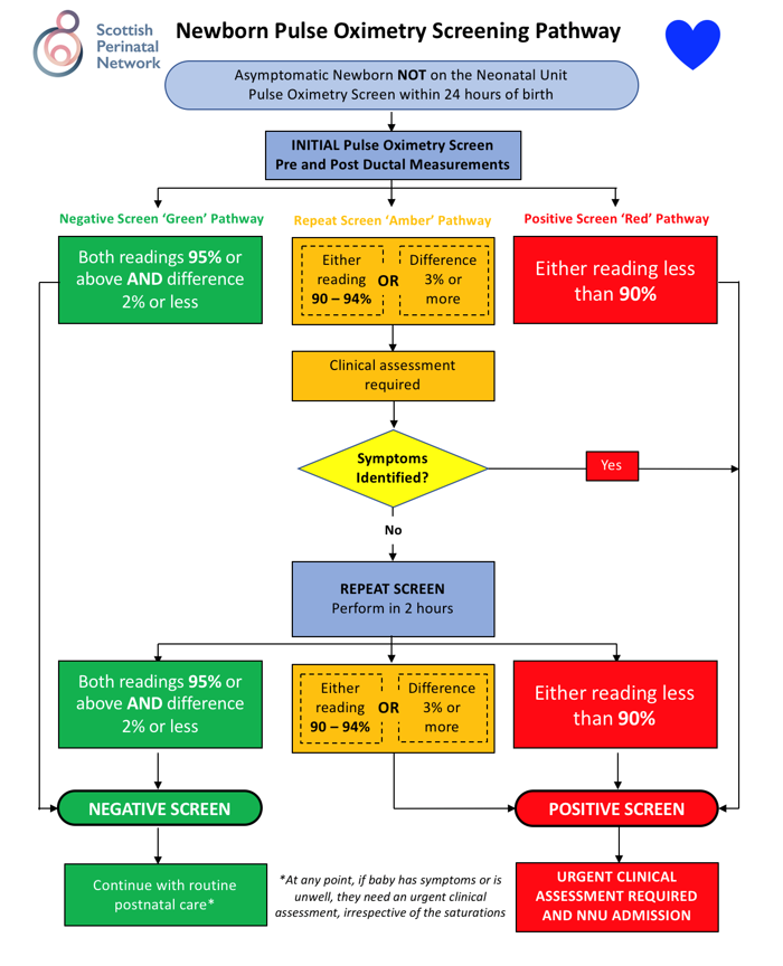
POS pathways are based on the pre and post-ductal oxygen saturation values and the difference between the 2 measurements. When the measurements are recorded, the baby is then assigned to a colour pathway. The dot chart below (Diagram 1) will help allocate a baby to the correct pathway based on their saturations.

  • Green (negative screen). Most babies will fall into this category.
  • Amber (needs a clinical review and, if well, a repeat POS in 2 hours)
  • Red (positive screen, needs urgent clinical review and possible NNU admission)

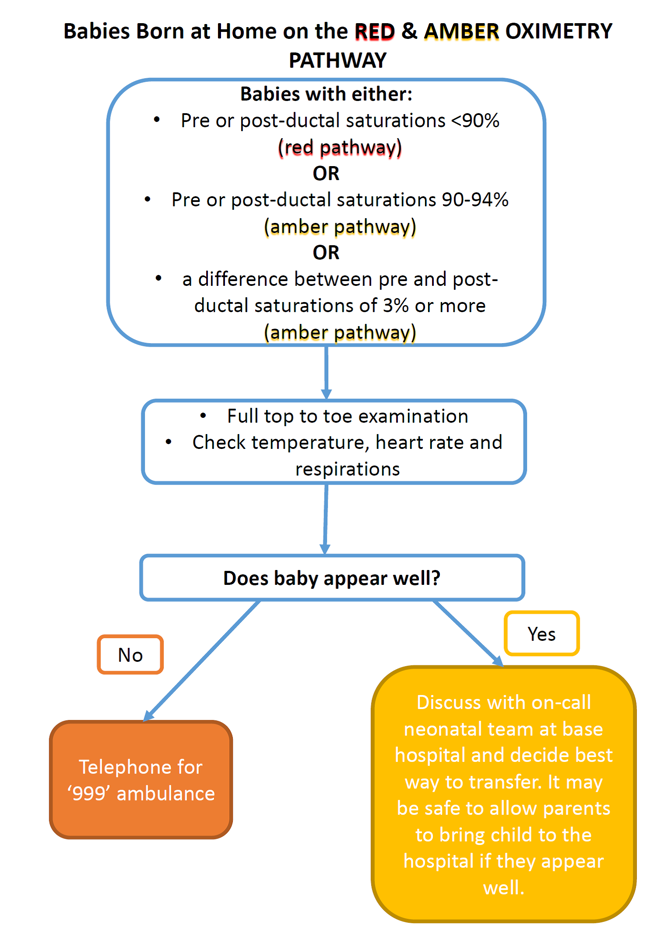
The flow chart below outlines the pathway the babies will follow dependent on their pre and post ductal saturations (Diagram 2).

6. Babies who require a Neonatal Review in Hospital

There are 3 circumstances in hospital when neonatal staff will be contacted:

  1. Baby on amber pathway
  2. Baby on red pathway
  3. Parent declining POS


a. Baby on Amber Pathway

Amber Pathway  
  • 3% of all babies will have borderline or differential saturations (difference 3% or more)
  • 90% will have normalised when the saturations are re-checked 2 hours later
  • All amber pathway babies must have a clinical neonatal review, ideally within 30 minutes or sooner if acuity permits.

Either
Difference
reading               OR               
3% or                         
90 - 94%                                  

  • It is not necessary to re-check the saturations at this medical review, unless there are clinical concerns about the baby.
  • If the baby is clinically well and there are no risk factors for infection, the baby can remain with mum and have a repeat POS 2 hours after the initial screen.
  • If the baby is clinically well, they do not need to go on a NEWS or NEWTT2 chart, as this will commit them to being in hospital for 12 hours of observations using NEWS or NEWTT2.
  • If there are clinical concerns on examination or signs suggestive of an underlying pathology (e.g., tachypnoea, grunting and borderline saturations) the baby should be admitted to neonatal unit for further monitoring and investigations. (See section 7 on initial NNU investigation and management).

After the POS is repeated at 2 hours, there are only 2 potential pathways:

  • Green or Red.

If the saturations remain borderline or the difference is 3% or more, the baby cannot be allocated the amber pathway again. This automatically diverts to the red pathway (see below).

b. Baby on the Red Pathway (positive screen):

  • Approximately 0.8% of all babies having POS will screen positive

There are 2 ways that a baby is assigned to the red pathway:

    • Saturations <90% at POS
    • Amber pathway (borderline or differential saturations) on initial and repeat POS
  • All babies on the red pathway must have an urgent medical review, within 10 minutes.
  • The saturations must be re-checked at this review because babies on the red pathway are automatically admitted to NNU for continuous saturation monitoring and for consideration of further investigations.

It is important to re-check saturations at this point to confirm they are low before separating mother and baby. (See section 7 on initial NNU investigation and management)

  • The receiving neonatal consultant should be informed of any baby on the red pathway who is admitted to NNU

c. Parents declining POS

Pulse oximetry screening is non-invasive and quick. Every parent should be given access to the parent information leaflet on POS. However, every parent has the right to decline screening tests. If the parent expresses reservations or declines, it is important to understand why:

  • Attend and discuss in a timely manner
  • Ensure that they have received and read the parent information leaflet
  • Use this when discussing with parents
  • Be explicit about the benefits, the non-invasive nature of the test and the reassurance that a negative screen provides
  • If parents still decline, document fully in notes of baby

7. Babies Admitted to the Neonatal Unit (NNU)

The majority of babies admitted to the NNU with low saturations following pulse oximetry screening will not have underlying cardiac pathology. More than half will have a respiratory cause, around 20% will have a transitional circulation and only 6-8% will have a cardiac cause. Therefore, investigations and management of the baby will be dependent on the differential diagnosis.

a. Differential Diagnosis:

In studies assessing POS, the most common differential diagnoses were:

  • Congenital pneumonia
  • Meconium aspiration
  • PPHN
  • Pneumothorax
  • Culture negative sepsis
  • GBS sepsis

 Cardiac causes included:

  • Transposition of the great arteries (TGA)
  • Critical pulmonary stenosis
  • Interrupted aortic arch (IAA)
  • Total anomalous pulmonary venous connection (TAPVC)
  • Hypoplastic left heart syndrome (HLHS)

The benefit from early detection of CCHD is predominantly the prevention of acute collapse and death. Therefore, the following lesions are key targets for pulse oximetry screening:

  • Hypoplastic left heart / single ventricle
  • Pulmonary atresia with intact ventricular septum
  • TGA
  • IAA
  • TAPVC
  • Coarctation of the aorta
  • Aortic stenosis
  • Tetralogy of Fallot

b. Initial Investigations and Management in the NNU

The investigations and management will be dependent on each individual case. The aim being to exclude or confirm cardiac or other pathology.  

Investigations /Management to consider:

  • Maternal History
  • Risk factors for sepsis
  • Meconium staining
  • Top to Toes examination, oxygen/respiratory support and observe response
  • Blood gas
  • CXR
  • Antibiotics
  • Continuous pre/post ductal saturations
  • Echo if no other explanation for persistent hypoxaemia

A baby on the red pathway does not automatically warrant an echocardiogram.

c. When to request an echocardiogram

The majority of babies admitted to the NNU via the red pathway of POS will not have cardiac pathology, therefore routine echocardiography in all babies is not advised.

Requesting of an echocardiogram should be a consultant decision.

There are 2 scenarios when an echocardiogram is advised:

  • Baby has no other reasonable explanation for their hypoxia (after investigation)
  • There are other indicators suggestive of cardiac lesion, such as a murmur or poor perfusion/weak pulses.

The urgency with which the echocardiogram is performed is dependent on the clinical condition of the baby.

In RHC cardiology have agreed that an echocardiogram can be requested without discussion with the on-call cardiology consultant in the event of a NNU admission for a red POS (baby not unwell and looking like delayed transition/sepsis).

In PRM/RAH this would be dependent on the team available and anticipation of likely transfer to RHC. The attending consultant neonatologist may conduct an initial echo to confirm cardiac aetiology. They can then consult with the cardiology team at RHC, receiving neonatal consultant at RHC and ScotSTAR in the event a transfer is required.  

Alternatively, the on-call cardiology team at RHC can be directly consulted for advice in relation to arranging an echocardiogram.

The unwell baby who needs an echocardiogram:

If the baby is becoming critically unwell with suspected congenital heart disease, there should be urgent discussion with on-call cardiology, consideration of a prostin infusion and, for those babies out-with RHC, discussions with ScotSTAR regarding potential transfer to RHC for further assessment.

d. Performing POS on the NNU

In babies admitted to the NNU POS should be performed very shortly before discharge from NNU.

This includes all babies who were born very preterm, as well as those who are late preterm or term who are admitted from labour ward or admitted before 6 hours of life.

Eligible Babies transferred back to the post-natal ward should have POS completed prior to transfer.

It is the responsibility of the neonatal unit medical team to ensure POS has been undertaken for EVERY baby prior to discharge.

Measure pre and post ductal saturations as previously discussed and assign the baby to a pathway (green, amber or red).

e. Documentation

Document the POS in the maternity badger. How we document this screening is vital.

It must be documented in Badger in Oxygen Saturations (even if done as part of the NIPE)
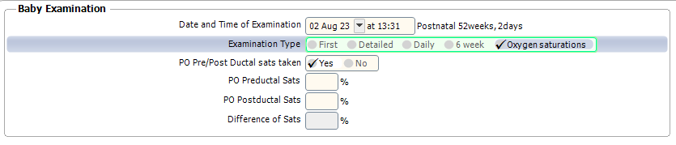
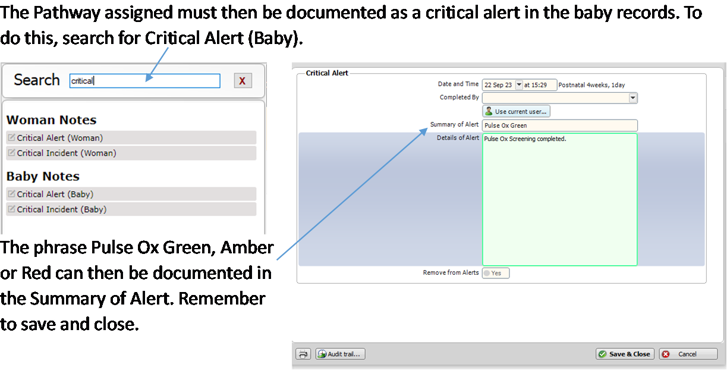
The Pathway assigned must then be documented as a clinical alert in the baby records e.g. Pulse Ox Green, Pulse Ox Amber or Pulse Ox Red (see below).
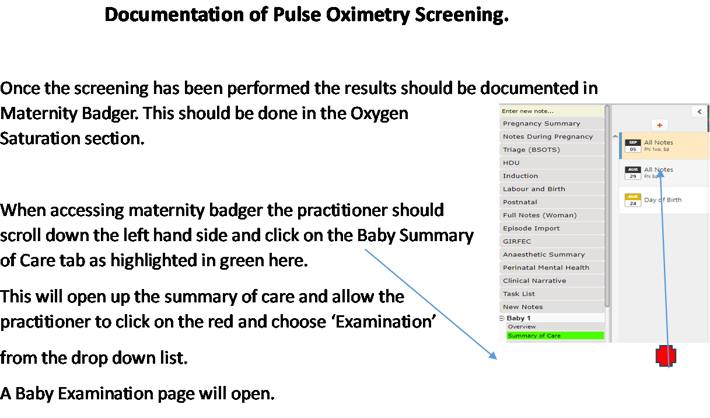
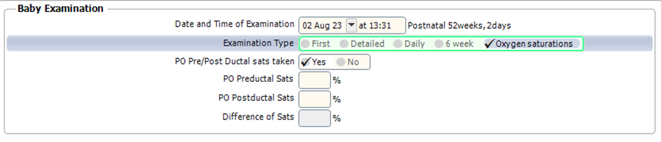
When the practitioner then clicks on the Oxygen Saturations box it should look like this. The preductal and post ductal sats must be documented on this form.
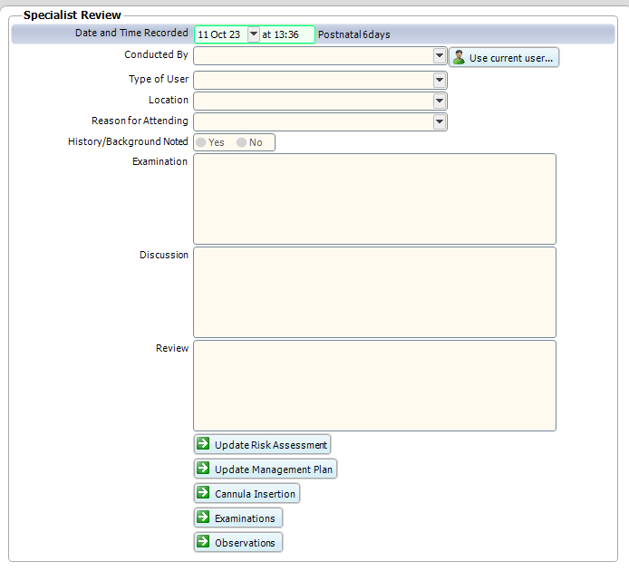
When Neonatal staff come to review an infant on the Amber or Red Pathway, they should document their plan in their Specialist Review (see below)

8. Home birth Pathway and Pulse Oximetry Screening

When babies are a planned home birth POS occurs within the first 24 hours, usually at the time of the first midwife visit (5).   

  Possible outcomes of POS at home (see Diagram 3):

  • Green pathway- no further saturation screening required.
  • Amber pathway – baby requires a medical review, and a repeat screen is required in 2 hours.
  • Red pathway- The baby will need to attend hospital for further assessment and review.
  • If the baby is unwell, advise to call 999 ambulance.

 Diagram 3

Editorial Information

Last reviewed: 19/01/2026

Next review date: 01/02/2029

Author(s): Greater Glasgow and Clyde Newborn Pulse Oximetry Team, Corresponding author: Dr Andrew MacLaren.

Version: 1.1

Author email(s): andrew.maclaren2@nhs.scot.

Approved By: RHC Neonatal Consultant Group

References
  1. Ewer AK, Middleton LJ, Furmston AT, et al. (2011) Pulse oximetry screening for congenital heart defects in newborn infants (PulseOx): a test accuracy study. Lancet. 2011;378(9793):785
  2. doi:10.1016/S0140-6736(11)60753-8
  3. NICOR, National Cardiac Audit Programme. (2018) Available at: https://www.nicor.org.uk/national-cardiac-audit-programme/congenital-audit-nchda (Accessed 27 November 2025).
  4. Abouk R, Grosse SD, Ailes EC, Oster ME. Association of US State Implementation of Newborn Screening Policies for Critical Congenital Heart Disease With Early Infant Cardiac Deaths [published correction appears in JAMA. 2018 Sep 25;320(12):1288]. JAMA. 2017;318(21):2111-2118. doi:10.1001/jama.2017.17627
  5. Singh A, Rasiah SV, Ewer AK. The impact of routine predischarge pulse oximetry screening in a regional neonatal unit. Arch Dis Child Fetal Neonatal Ed. 2014;99(4):F297-F302. doi:10.1136/archdischild-2013-305657
  6. Cawsey MJ, Noble S, Cross-Sudworth F, Ewer AK. Feasibility of pulse oximetry screening for critical congenital heart defects in homebirths. Arch Dis Child Fetal Neonatal Ed. 2016 Jul;101(4):F349-51.